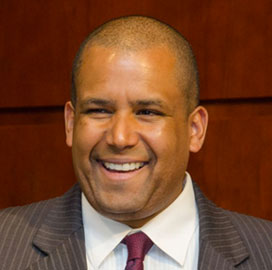
Brodi Fontenot, currently a Transportation Department official, has received a presidential nomination to serve as the Treasury Department‘s next chief financial officer, the White House announced Thursday.
Fontenot’s roles at DOT include assistant secretary for administration, chief human capital officer and senior sustainability officer.
He joined that agency in 2009 as deputy assistant secretary of management and budget after serving on the Senate Budget Committee’s staff for three years.
Between 2001 and 2006, he worked as a Government Accountability Office analyst and helped the agency with budgeting, disaster assistance and housing matters.
He holds a master of public administration degree from the University of North Carolina and a bachelor’s degree from the University of Houston.
-Mary-Louise Hoffman, ExecutiveGov.com
READ MORE...
Showing posts with label Budget Formulation and Execution. Show all posts
Showing posts with label Budget Formulation and Execution. Show all posts
Friday, August 01, 2014


Tuesday, March 04, 2014
Budget proposal fleshes out OMB's management agenda
More than six months after President Barack Obama announced his second-term management agenda, the Office of Management and Budget is putting some specifics behind it.
As part of the fiscal 2015 budget request sent to Congress Tuesday, the administration described initiatives around improving customer service at the IRS and the Social Security Administration. OMB also plans to fund and launch a civilian property realignment board and to include more funding for the National Science Foundation and the National Institute of Standards and Technology to make federally funded data more widely available.
OMB said it will also launch new and improved employee training programs and three pilot programs to enhance how agencies hire employees.
"The agenda is focused on delivering a 21st century government that is more effective, efficient and supportive of economic growth," said Beth Cobert, OMB's deputy director for management, Tuesday during a teleconference with reporters.
Cobert said the management agenda is focused on four themes:
- Effectiveness — delivering better, faster, smarter services to citizens and businesses.
- Efficiency — increasing quality and value in the government's core administrative functions.
- Economic growth — opening government funded data and research to the public to spur innovation and economic growth.
- People and culture — unlocking the full potential of the federal workforce and building the workforce the government needs for the future.
- Jason Miller, FederalNewsRadio.com
READ MORE...
Thursday, August 29, 2013
Agencies' FY 2015 budget planning 'tied up in knots' by uncertainty
The budget situation for fiscal 2014 is still murky. Funding for the current year runs out Sept. 1, there's no word on a budget or even a stopgap continuing resolution and the across-the-board sequestration cuts are still threatening to gum up the works.
-Jack Moore, FederalNewsRadio.com
READ MORE and LISTEN HERE...
But, believe it or not, agencies are already planning for their 2015 budgets. Preliminary plans are due to the Office of Management and Budget next month.
But with no funding deal in sight for the next fiscal year, how can agencies already be planning for the following year?
"I think it's safe to say, agencies are used to this situation," said Robert Shea, a former OMB official in the George W. Bush administration and now a principal at Grant Thornton in an interview on In Depth with Francis Rose.
Agencies have, by and large, become inured to widespread budget uncertainty, Shea said. For example, last year, there were five stopgap funding measures, which kept government spending afloat in the absence of a full-year budget. The year prior, there were eight.
OMB has also provided exhaustive guidelines for agencies as they plot out their budgets.
In May, the Office of Management and Budget released guidance directing agencies to cut discretionary spending by 10 percent by targeting low-priority programs.
But while it's possible for agencies to plan budget reductions amid so much uncertainty, it's still not an optimal situation.
Congress returns to Washington from its August recess in a few weeks, but House and Senate leaders and appropriators have been mum, so far, on any funding deal that spells out how to deal with sequestration.
Still, even that seems a remote possibility, Shea said. "I hate to be a pessimist, but I think we're likely to see FY '14 and '15 look a lot like '13."
-Jack Moore, FederalNewsRadio.com
READ MORE and LISTEN HERE...
Friday, April 12, 2013
5 trends and hurdles for the future of effective financial management
All week long, as part of the Federal News Radio special report, "Rise of the Money People," we've tracked best practices, key personalities and new policies in the financial-management realm.
TREND - Shared Services
TREND - Data driving decisions
TREND - Expansion of the CFO role
The CFO role of the future is about high-level decision-making rooted in high- quality data, he said.
HURDLE - Shrinking budgets
HURDLE - Cultivating a workforce amid decline
-Jack Moore, FederalNewsRadio.com
READ MORE...
Today, we turn to the future, examining the three emerging trends that could help federal agencies and their chief financial officers get a better grip on improving their financial systems and the two significant hurdles that stand in their way.
TREND - Shared Services
In terms of financial-management modernization, the new name of the game is shared services.
The Office of Management and Budget made that clear last month when it issued a new final policymandating agencies use a federal shared-services provider when updating their financial systems.
Too often, as agencies went about updating their accounting systems, their plans to build costly new programs from the ground up ran over-budget and behind schedule. OMB paused many agencies' modernization initiatives in the summer of 2010
The earlier approach simply isn't working, said Peggy Sherry, the CFO of the Homeland Security Department.
"They take too long; they're too expensive. ... At the end of the day, they often lead to results that are not what you intended especially as it relates to cost, quality and performance," she said.
Sherry knows firsthand difficulties in modernization efforts.
Over the past few years, DHS twice tried and failed to consolidate 13 different accounting systems into a single, all-encompassing system.
DHS has now opted for more incremental improvements to its financial- management structure. Shared services is a "key element" of the agency's approach, Sherry said.
TREND - Data driving decisions
Especially given the budget environment, using data to drive better results is critical, Sherry said.
"We spend an awful lot of money in the government, but we don't necessarily have a way to be able to look across the portfolio at what that information is," Sherry said. "We don't necessarily collect the data in a consistent manner. So, it's challenging to be able to get quality information and then to be able to do apples-to-apples comparisons."
Even within a single agency, there's often no easy way to find out what various components or regions are paying for a particular service, she said.
The Office of Management and Budget is attempting to combat that lack of awareness with what it calls the "prices-paid portal."
"It's a data warehouse for federal agencies to understand what we're paying for stuff and what our colleagues are paying across government," said OMB Controller Danny Werfel in a keynote address at the Association of Government Accountants summit in February. "It's putting into a single platform information so that we can be smarter about what goods and services to the government cost."
Getting a handle on that basic information will help power a broader inventory of data about what the government owns, what it pays for services, and where agencies can share resources and services, he explained.
TREND - Expansion of the CFO role
From green eyeshade accountants to "master data analyzers," the role of the CFO has evolved since the CFO Act codified the role in 1990.
Part of that transformation has been driven by an increasing cooperation and stronger relationship between agency CFOs and their counterparts on the technology side of the agency — the chief information officer.
The CIO community talks a lot about governance and best practice, Sherry said, two key themes that CFOs can also take to heart.
The emerging reality is that "we are not going to be successful as a financial- management community working in a vacuum," Werfel said in his AGA speech. "We have to take a very integrative approach to managing our organizations and to being successful."
But the CFO role is also broadening in and of itself, moving away from nuts-and- bolts issues.
The CFO role of the future is about high-level decision-making rooted in high- quality data, he said.
HURDLE - Shrinking budgets
The biggest stormcloud on the horizon, as any CFO would say, remains the budget.
Each year, budget pressures seem to grow more acute, Werfel said in his AGA keynote address.
"Obviously, this year, the budget uncertainty that we face is no longer amorphous, it's become tangible and real," he said.
In an exclusive Federal News Radio survey of CFOs and deputy CFOs, sequestration (and the need to find efficiencies to comply with the steep across-the-board cuts) ranked as CFOs' top priority.
And financial-systems modernization, which is exceedingly complex and expensive, is vulnerable to the budget pressure.
HURDLE - Cultivating a workforce amid decline
As budgets are squeezed, federal employees are asked to take on ever greater responsibility even as waves of retirements and early-outs have reduced staff sizes.
Agency CFOs face particular challenges in growing and cultivating their workforces.
Hiring and retaining the workforce and providing more training are top of mind for CFOs, ranking second and third on a list of their top 2013 priorities, according to the survey.
Fortunately, despite these pressures, those emerging trends in financial management — shared services, data-driven decision-making and others — can offer CFOs some solace.
But agency money people will also need to apply some old-fashioned leadership. There are no cure-alls in the CFO toolbox.
Despite the difficulties, it is in just this type of budget environment that CFOs can shine, by leveraging both new technologies and time-tested best practices.
-Jack Moore, FederalNewsRadio.com
READ MORE...
Tuesday, April 09, 2013
Three steps to make it out of the impenetrable (financial) fog
In April 1802, Thomas Jefferson wrote of an "impenetrable fog," much like the one that frequently blankets the nation's capital during the spring months, though the fog he referred to was perhaps not the first one that comes to mind. Instead, the fog of which the third president of the country penned was the one enveloping the financial management system at our highest level of government.
As President Barack Obama begins his second term, a new OMB director will be taking office to shape his legacy in financial management. I believe this is a great opportunity for this administration to accomplish some game-changing results in the financial management arena without risking hundreds of million of dollars in new systems or hiring armies of consulting contractors to reinvent the wheels. If the new OMB director seizes the opportunity to update the management structure that stymied most former directors, she will put into place an historic exemplar that may be one of President Obama's most long-lasting impacts. It will also be a giant step towards fulfilling Mr. Jefferson's vision from over 200 years ago.
The key to this revamping lies in a single letter of the office's acronym: putting the "M" back in OMB by fully implementing the CFO Act of 1990 in all Cabinet agencies and strengthening the CFO structure within the agency leadership team accordingly.
A quick examination of the current OMB organizational chart will reveal that there is no CFO for the entire federal government, but there is a federal CTO, CIO, etc. Furthermore, the staffing and resources given to the "controller" pale in comparison to those of the budget examiners organization. The Controller of the United States at OMB is like the Treasurer of the United States. Both have grandiose titles, but no real authority over key management operations or programs. The OMB Controller's Office is so thinly staffed and sparsely resourced that it is severely limited in its ability to function as an effective first among equals within the cabinet CFO community.
-Sam Mok, FederalNewsRadio.com
READ MORE...
Mr. Jefferson wrote about the "great importance to simplify our system of finance and bring it within the comprehension of every member of Congress," and his goal was that "the finances of the Union be as clear and intelligible as a merchant's books, so that every member of Congress, and every man of any mind in the Union, should be able to comprehend them to investigate abuses, and consequently to control them."
Unfortunately, 211 years later, to the month, "impenetrable fog" can still be used to describe the state of financial management in the federal government.
The key to this revamping lies in a single letter of the office's acronym: putting the "M" back in OMB by fully implementing the CFO Act of 1990 in all Cabinet agencies and strengthening the CFO structure within the agency leadership team accordingly.
A quick examination of the current OMB organizational chart will reveal that there is no CFO for the entire federal government, but there is a federal CTO, CIO, etc. Furthermore, the staffing and resources given to the "controller" pale in comparison to those of the budget examiners organization. The Controller of the United States at OMB is like the Treasurer of the United States. Both have grandiose titles, but no real authority over key management operations or programs. The OMB Controller's Office is so thinly staffed and sparsely resourced that it is severely limited in its ability to function as an effective first among equals within the cabinet CFO community.
-Sam Mok, FederalNewsRadio.com
READ MORE...
Thursday, March 14, 2013
Crisis Budgeting Creates an 'Uncertainty Tax,' Senator Says
The uncounted hours federal employees have spent planning for budget contingencies amid political and fiscal uncertainty reduce agency productivity and lower morale, witnesses told a Senate panel on Wednesday.
The Senate Homeland Security and Governmental Affairs Committee hearing came just as President Obama and the House and Senate Budget committees met on Capitol Hill but made little progress toward a solution to the fiscal stalemate.
“By failing to provide timely, predictable budgets we are generating waste throughout our government and exporting some of that waste to our state and local partners and everyone who relies on us,” said Sen. Tom Carper, D-Del., chairman of the committee.
The absence of timely budgets, he said, creates “an uncertainty tax.”
Sen. Tom Coburn, R-Okla., agreed with Carper that the budget crisis is “a bipartisan failure of leadership.” The reason the Senate has not enacted a budget in four years, Coburn said, is that “it has sought not to meet the needs of government but to meet needs of politicians, focusing on the short-term and not the long-term.” The fact that Congress failed to pass all 12 spending bills in 18 of the last 24 years and relied on continuing resolutions, he said, “kills the agencies. It doesn’t allow for judgment or let them do what they’re supposed to do. The inefficiency and the increased cost I would lay at the feet of Congress and the president.”
Routine CRs are “at least as worthy of attention, and may indeed be more damaging, than sequestration or brief government shutdowns,” Philip Joyce, a professor of management, finance, and leadership at the University of Maryland School of Public Policy and author of a recent study on the harm from late budgets, testified. “Some of these costs are financial, and some represent inefficiencies and compromised effectiveness for federal programs. All of these negative impacts are self-inflicted, however, and are entirely preventable.”
Budget uncertainty also affects the federal workforce, Joyce added. “People leave government because of lowered morale,” he said, “and they’re not necessarily the ones you want to leave.”
He also noted that despite the Office of Management and Budget’s early prohibition on planning for sequestration for fear of harming productivity, “any rational agency would begin planning given what they could see coming. And once OMB pulled the switch, they went into high gear. But nothing about developing these plans contributes to mission success of these agencies.”
Witnesses’ recommendations for fixing the problem ranged from biennial budgeting, to improved communication with agencies, to banning continuing resolutions or limiting their duration to giving agency budget planners more freedom to move funds around when they arrive late.
Most agreed that wasteful spending can be found to ease the budget stalemate. “Congress doesn’t do a good job of oversight and tends to oversee a crisis but not the operations,” said Sen. Mark Begich, D-Alaska. “Congress doesn’t do enough review of whether this or that program should exist.”
-Charles S. Clark, GovExec.com
READ MORE...
Thursday, February 28, 2013
OMB Expands Sequestration Guidance, Increasing Scrutiny of Expenses
With just a day to go before the onset of sequestration, the Office of Management and Budget on Wednesday evening supplied federal agency heads with expanded guidance on how to begin implementing across-the-board spending cuts.
Unless Congress and the president achieve a new budget deal by Friday, wrote Controller Danny Werfel in a Feb. 27 memorandum, agencies must now execute $85 billion in cuts over seven months, which translates to about 9 percent for nondefense programs and 13 percent for defense programs. “These reductions will result in significant and harmful impacts to national security and domestic priorities,” he said.
Detailed instructions addressed processes for planning, communication, adjustments to acquisition, protecting recipients of financial aid and “increased scrutiny of certain activities.” That last category directs managers to employ “risk management strategies and internal controls” to scrutinize spending on hiring new personnel; issuing “discretionary monetary awards to employees, which should occur only if legally required until further notice;” and incurring obligations for new training, conferences, and travel (including agency-paid travel for non-agency personnel).
In light of reduced funding, Werfel wrote, managers should be “actively and continuously communicating with affected stakeholders -- including states, localities, tribal governments, federal contractors, federal grant recipients and federal employees."
Agencies should “identify any major contracts that they plan to cancel, re-scope or delay as well as any grants that they plan to cancel, delay, or for which they plan to change the payment amount,” the memo said. “Agencies should only enter into new contracts or exercise options when they support high-priority initiatives or where failure to do so would expose the government to significantly greater costs in the future. Agencies may also consider de-scoping or terminating for convenience contracts that are no longer affordable within the funds available.”
-Charles S. Clark, GovExec.com
READ MORE...
Thursday, December 20, 2012
OMB delaying budget passback guidance, creating uncertainty
The fiscal 2014 budget is on hold.
Agency officials across the government have not received budget passback documents and likely will not until the White House and Congress agree on deficit reduction steps or both parties give up and let sequestration take place. An Office of Management and Budget official confirmed in an email to Federal News Radio the administration "has held off on passbacks to agencies to determine if adjustments will be needed based on the current negotiations. No decisions have been made at this point regarding budget timing." OMB traditionally sends passback, or budget guidance, which includes both actual spending numbers and policy guidance for the current and upcoming fiscal year, right around Thanksgiving. But several long-time senior agency leaders said they can't remember a time when OMB held up the communications this long.
OMB did provide agencies with initial planning guidance in May, but nothing since departments submitted their spending requests to the White House in September.
The OMB official said they asked agencies for additional information and analysis after September to update the estimates in the Sequestration Transparency Act report. The administration is using the data to finalize calculations of the spending reductions that would be required. The request was of a technical nature. For example, OMB requested the sequestrable federal administrative expenses in otherwise exempt mandatory accounts.
-Jason Miller, FederalNewsRadio.com
READ MORE...
Agency officials across the government have not received budget passback documents and likely will not until the White House and Congress agree on deficit reduction steps or both parties give up and let sequestration take place. An Office of Management and Budget official confirmed in an email to Federal News Radio the administration "has held off on passbacks to agencies to determine if adjustments will be needed based on the current negotiations. No decisions have been made at this point regarding budget timing." OMB traditionally sends passback, or budget guidance, which includes both actual spending numbers and policy guidance for the current and upcoming fiscal year, right around Thanksgiving. But several long-time senior agency leaders said they can't remember a time when OMB held up the communications this long.
OMB did provide agencies with initial planning guidance in May, but nothing since departments submitted their spending requests to the White House in September.
The OMB official said they asked agencies for additional information and analysis after September to update the estimates in the Sequestration Transparency Act report. The administration is using the data to finalize calculations of the spending reductions that would be required. The request was of a technical nature. For example, OMB requested the sequestrable federal administrative expenses in otherwise exempt mandatory accounts.
-Jason Miller, FederalNewsRadio.com
READ MORE...
Friday, July 06, 2012
OMB tells CFOs to run SAVE Award ideas by broader audience
The White House is using a restaurant-style rating system for the 2012 SAVE Award contest, and it wants agency chief financial officers to be the food critics.
The administration is asking federal employees to rank money-saving ideas with one, two or three stars — with three being the top-rated, most likely to save the government money.
"In addition to reviewing and rating each SAVE Award submission, CFOs should pay particular attention to those submissions that their agency ranks most favorably," wrote Danny Werfel, the controller of the Office of Management and Budget, in a June 27 memo to CFOs. "The MAX Community site will include a check-box to indicate that the 'Idea is Recommended' by the agency. Agencies should provide this designation to the best candidates for consideration of the SAVE Award. This designation should be limited to between five and 10 ideas per agency, depending on the size of the agency and the number of submissions. Before an agency indicates that a particular idea is recommended by checking this box, the CFO must confirm with internal agency programmatic, operations, communications and other stakeholders, as well as agency leadership, that all parties are comfortable with moving forward with the idea should it ultimately be selected as a finalist for the SAVE Award."
The administration will kick off the 2012 SAVE Award contest in a few weeks and provide agencies with a list of ideas in the next two months, Werfel said.
"To avoid repeating ideas, to the degree practical, agencies are encouraged to review recommended SAVE award submissions from prior years to determine whether analysis has already been done about the validity and merits of a particular idea," Werfel wrote. "These ratings and recommendations will serve as the starting point for a deliberative process to determine which submissions may be considered as finalists for the SAVE Award. Following submission of agency ratings of SAVE Award candidates, OMB staff will review the submissions and engage further with agencies as appropriate."
The 2012 guidance is different than the 2011 memo. Werfel is asking CFOs to work more closely with the program areas before finalizing their list of money saving ideas.
-Jason Miller, FederalNewsRadio.com
READ MORE...
The administration is asking federal employees to rank money-saving ideas with one, two or three stars — with three being the top-rated, most likely to save the government money.
"In addition to reviewing and rating each SAVE Award submission, CFOs should pay particular attention to those submissions that their agency ranks most favorably," wrote Danny Werfel, the controller of the Office of Management and Budget, in a June 27 memo to CFOs. "The MAX Community site will include a check-box to indicate that the 'Idea is Recommended' by the agency. Agencies should provide this designation to the best candidates for consideration of the SAVE Award. This designation should be limited to between five and 10 ideas per agency, depending on the size of the agency and the number of submissions. Before an agency indicates that a particular idea is recommended by checking this box, the CFO must confirm with internal agency programmatic, operations, communications and other stakeholders, as well as agency leadership, that all parties are comfortable with moving forward with the idea should it ultimately be selected as a finalist for the SAVE Award."
The administration will kick off the 2012 SAVE Award contest in a few weeks and provide agencies with a list of ideas in the next two months, Werfel said.
"To avoid repeating ideas, to the degree practical, agencies are encouraged to review recommended SAVE award submissions from prior years to determine whether analysis has already been done about the validity and merits of a particular idea," Werfel wrote. "These ratings and recommendations will serve as the starting point for a deliberative process to determine which submissions may be considered as finalists for the SAVE Award. Following submission of agency ratings of SAVE Award candidates, OMB staff will review the submissions and engage further with agencies as appropriate."
The 2012 guidance is different than the 2011 memo. Werfel is asking CFOs to work more closely with the program areas before finalizing their list of money saving ideas.
-Jason Miller, FederalNewsRadio.com
READ MORE...
Tuesday, June 12, 2012
OMB directs agencies to use evidence-based budgeting
The White House wants agency budgets to be based on evidence showing programs actually work.
That means agencies will have to show a return on the investment on their programs, with more successful programs being more likely to receive funding.
In a memo last month, OMB Acting Director Jeff Zeints directed agencies to use evidence and "rigorous evaluation" in submitting their 2014 budgets.
The prioritization of programs is even more crucial because OMB has told agencies it must cut their budgets by 5 percent for their 2014 requests.
The budget agency is encouraging agencies to use administrative data or new technology and to expand evaluation efforts.
-Jolie Lee, FederalNewsRadio.com
READ MORE or LISTEN HERE...
That means agencies will have to show a return on the investment on their programs, with more successful programs being more likely to receive funding.
In a memo last month, OMB Acting Director Jeff Zeints directed agencies to use evidence and "rigorous evaluation" in submitting their 2014 budgets.
The prioritization of programs is even more crucial because OMB has told agencies it must cut their budgets by 5 percent for their 2014 requests.
The budget agency is encouraging agencies to use administrative data or new technology and to expand evaluation efforts.
-Jolie Lee, FederalNewsRadio.com
READ MORE or LISTEN HERE...
Monday, May 21, 2012
Recent OMB Memoranda
Office of Management and Budget - Budget Guidance (5% cut)
Link: http://www.whitehouse.gov/sites/default/files/omb/memoranda/2012/m-12-13.pdf
Renewed emphasis on evaluation:
Link: http://www.whitehouse.gov/sites/default/files/omb/memoranda/2012/m-12-14.pdf
“Administration’s Management Agenda” defined:
Link: http://www.whitehouse.gov/sites/default/files/omb/memoranda/2012/m-12-14-attachment.pdf
Link: http://www.whitehouse.gov/sites/default/files/omb/memoranda/2012/m-12-13.pdf
Renewed emphasis on evaluation:
Link: http://www.whitehouse.gov/sites/default/files/omb/memoranda/2012/m-12-14.pdf
“Administration’s Management Agenda” defined:
Link: http://www.whitehouse.gov/sites/default/files/omb/memoranda/2012/m-12-14-attachment.pdf
Wednesday, February 15, 2012
Treasury Consolidation Would Merge Debt Division.
The White House on Monday said it wanted to consolidate the Bureau of Public Debt and the Financial Management Service within the Fiscal Service, another Treasury division. They say it will “streamline and modernize operations.”
“The consolidation also strengthens Treasury’s leadership of Federal financial management issues, reduces costs, and enhances efficiencies by further modernizing Federal financial management processes,” the White House said. It’s unclear how much money it will actually save.
-Damian Palleta, WSJ.com
READ MORE...
“The consolidation also strengthens Treasury’s leadership of Federal financial management issues, reduces costs, and enhances efficiencies by further modernizing Federal financial management processes,” the White House said. It’s unclear how much money it will actually save.
-Damian Palleta, WSJ.com
READ MORE...
Monday, February 13, 2012
OMB Releases FY 2013 Budget to Congress
OMB Releases Fiscal Year 2013 Budget to Congress. Find the budget and tools to review it at the link below.
READ MORE...
READ MORE...
Friday, February 10, 2012
How will agency tech, financial management initiatives fare in 2013 budget?
The massive federal budget request will be unveiled Monday, and some agencies may see some shrinkage in their IT budgets this coming year.
Anne Reed, the chairman of the board of ASI Government, joined In Depth with Francis Rose to discuss the 2013 budget request and its impact on technology and financial management.
Reed addressed whether much stock should be put in the official budget since Congress has a spotty track record of even considering, let alone passing, budgets much before the end of the fiscal year.
She also shared advice for agency managers, who may find themselves in the middle of a multi-year project that has its funding cut as well as potential areas for contractors.
-FederalNewsRadio.com
READ MORE and LISTEN HERE...
Anne Reed, the chairman of the board of ASI Government, joined In Depth with Francis Rose to discuss the 2013 budget request and its impact on technology and financial management.
Reed addressed whether much stock should be put in the official budget since Congress has a spotty track record of even considering, let alone passing, budgets much before the end of the fiscal year.
She also shared advice for agency managers, who may find themselves in the middle of a multi-year project that has its funding cut as well as potential areas for contractors.
-FederalNewsRadio.com
READ MORE and LISTEN HERE...
Thursday, February 02, 2012
House Budget Committee Advances Common-Sense Budget Process Reforms
House Budget Committee Advances Common-Sense Budget Process Reforms
Chairman Ryan applauds effort to bring greater transparency and accountability to the budget process
January 24, 2012
WASHINGTON – The House Budget Committee advanced three legislative reforms today to address the broken budget process. The reforms focused on bringing greater accountability and transparency, and stronger protections for hardworking Americans’ tax dollars. While the House Budget Committee works to advance solutions, today marks 1,000 days without any budget from the U.S. Senate.
H.R. 3582 – The Pro-Growth Budgeting Act of 2012
This bill would require that for major legislation that CBO prepare an analysis of the effect that the legislation would have on the U.S. economy. This macroeconomic impact analysis would be supplemental information in addition to the official congressional cost estimate of the legislation.
H.R. 3578 – The Baseline Reform Act of 2012
Under current law the baseline assumes ever higher spending as discretionary accounts are annually increased by inflation and for a number of other factors. This legislation levels the playing field and removes this pro-spending bias.
H.R. 3581 – The Budget and Accounting Transparency Act of 2012
This bill increases transparency in federal budgeting by reforming the way certain costs are calculated and requiring that certain costs incurred by the Federal government are included in the budget.
READ MORE...
Chairman Ryan applauds effort to bring greater transparency and accountability to the budget process
January 24, 2012
WASHINGTON – The House Budget Committee advanced three legislative reforms today to address the broken budget process. The reforms focused on bringing greater accountability and transparency, and stronger protections for hardworking Americans’ tax dollars. While the House Budget Committee works to advance solutions, today marks 1,000 days without any budget from the U.S. Senate.
H.R. 3582 – The Pro-Growth Budgeting Act of 2012
This bill would require that for major legislation that CBO prepare an analysis of the effect that the legislation would have on the U.S. economy. This macroeconomic impact analysis would be supplemental information in addition to the official congressional cost estimate of the legislation.
H.R. 3578 – The Baseline Reform Act of 2012
Under current law the baseline assumes ever higher spending as discretionary accounts are annually increased by inflation and for a number of other factors. This legislation levels the playing field and removes this pro-spending bias.
H.R. 3581 – The Budget and Accounting Transparency Act of 2012
This bill increases transparency in federal budgeting by reforming the way certain costs are calculated and requiring that certain costs incurred by the Federal government are included in the budget.
READ MORE...
Wednesday, February 01, 2012
CBO Releases "The Budget and Economic Outlook: Fiscal Years 2012 to 2022"
The Budget and Economic Outlook: Fiscal Years 2012 to 2022
Find the CBO Page Here...
Download the PDF...
Go to the CBO Blog...
Find the CBO Page Here...
Download the PDF...
Go to the CBO Blog...
Thursday, January 26, 2012
Agency CFOs feel strain of impending budget cuts
Federal chief financial officers and deputy CFOs are feeling more pressure to help their agencies deal with impending budget cuts.
With the White House planning to release the fiscal 2013 budget request Feb. 13, agency CFOs and deputy CFOs said in an exclusive online survey by Federal News Radio that their top three priorities and challenges all revolve around improving how their agency manages spending. Agencies expect the 2013 request to include significant cuts in across-the-board discretionary spending.
CFOs and deputy CFOs said helping their agencies deal with budget cuts is their top priority for 2012 with an average ranking of 1.9 out of eight choices. Respondents ranked second "helping my agency use financial data to make better decisions." Reducing improper payments, solving data quality and integrity issues, and modernizing or improving their agency's general ledger financial systems rounded out their top five priorities.
CFOs and deputy CFOs also worried that their workforces are not ready to help them use data to make better decisions or to figure out how best to save money. In two related questions, a majority of respondents said their workforces needed help.
And finally, when asked to rate priorities on a scale of 1-to-5, with five being very important, workforce training received the highest average rank of 2.7, while reducing improper payments (2.8) and cutting costs (2.82) rounded out the top three.
At the same time, however, CFOs and deputy CFOs said the biggest challenge facing the financial-management community was budget reductions and too many unfunded mandates, while workforce issues ranked much lower.
While workforce training is a major concern, only 9 percent of respondents said they were likely to move their financial-management system to a shared-service provider in 2012. Just under half of the respondents, 45 percent, said they do not plan on using the Treasury Department's electronic payment processing system in 2012 either.
CFOs and deputy CFOs gave good marks to Treasury's 12-step plan to improve financial management, with 46 percent saying it's making a difference. But 37 percent said it's moving too slowly — so there seems to be agreement and also desire for improving the federal financial management process.
In fact, 55 percent said the 1990 CFO Act needs to be updated, while 18 percent said there are some parts that need to be revised.
Finally, CFOs were unsure how the Government Accountability and Transparency (GAT) Board would affect the government. Of the respondents, 18 percent said it will improve oversight and help gain control of spending, 36 percent said it will be another bureaucratic oversight body and 46 percent said it was too early to tell if it will help or hurt.
-Jason Miller, FederalNewsRadio
READ MORE OR LISTEN HERE...
With the White House planning to release the fiscal 2013 budget request Feb. 13, agency CFOs and deputy CFOs said in an exclusive online survey by Federal News Radio that their top three priorities and challenges all revolve around improving how their agency manages spending. Agencies expect the 2013 request to include significant cuts in across-the-board discretionary spending.
CFOs and deputy CFOs said helping their agencies deal with budget cuts is their top priority for 2012 with an average ranking of 1.9 out of eight choices. Respondents ranked second "helping my agency use financial data to make better decisions." Reducing improper payments, solving data quality and integrity issues, and modernizing or improving their agency's general ledger financial systems rounded out their top five priorities.
CFOs and deputy CFOs also worried that their workforces are not ready to help them use data to make better decisions or to figure out how best to save money. In two related questions, a majority of respondents said their workforces needed help.
And finally, when asked to rate priorities on a scale of 1-to-5, with five being very important, workforce training received the highest average rank of 2.7, while reducing improper payments (2.8) and cutting costs (2.82) rounded out the top three.
At the same time, however, CFOs and deputy CFOs said the biggest challenge facing the financial-management community was budget reductions and too many unfunded mandates, while workforce issues ranked much lower.
While workforce training is a major concern, only 9 percent of respondents said they were likely to move their financial-management system to a shared-service provider in 2012. Just under half of the respondents, 45 percent, said they do not plan on using the Treasury Department's electronic payment processing system in 2012 either.
CFOs and deputy CFOs gave good marks to Treasury's 12-step plan to improve financial management, with 46 percent saying it's making a difference. But 37 percent said it's moving too slowly — so there seems to be agreement and also desire for improving the federal financial management process.
In fact, 55 percent said the 1990 CFO Act needs to be updated, while 18 percent said there are some parts that need to be revised.
Finally, CFOs were unsure how the Government Accountability and Transparency (GAT) Board would affect the government. Of the respondents, 18 percent said it will improve oversight and help gain control of spending, 36 percent said it will be another bureaucratic oversight body and 46 percent said it was too early to tell if it will help or hurt.
-Jason Miller, FederalNewsRadio
READ MORE OR LISTEN HERE...
Monday, November 28, 2011
Are agency CFOs up for budget battles?
The federal budget environment — complicated by Congress and the shifting political winds — has only made the job of federal chief financial officer and budget teams that much more difficult.
But the good news is, they say they're looking forward to the challenge, said Jonathan Stehle, president of the American Association for Budget and Program Analysis, in an interview on In Depth with Francis Rose.
That was also the theme that emerged from a recent AABPA report, "The Road Forward, The Federal Budget and Budgeting Profession."
-Jack Moore, FederalNewsRadio.com
READ MORE...
But the good news is, they say they're looking forward to the challenge, said Jonathan Stehle, president of the American Association for Budget and Program Analysis, in an interview on In Depth with Francis Rose.
That was also the theme that emerged from a recent AABPA report, "The Road Forward, The Federal Budget and Budgeting Profession."
-Jack Moore, FederalNewsRadio.com
READ MORE...
Wednesday, November 16, 2011
The Road Forward: The Federal Budget and Budgeting Profession
In 2011, Grant Thornton joined forces with the American Association for Budget and Program Analysis (AABPA) for a first-time, online survey of 231 federal budget professionals. Survey topics included budget formulation and execution, budget and performance integration, budget cutting, Congress, budget technology, and human capital. The survey finds budgeteers primed for the coming budget battles.
Other findings include:
Download the report Here..
Other findings include:
- Preparing and justifying budgets remains their most important job.
- Integrating budget and performance data is critical for program success but underlying difficulties make this problematic.
- Budgeteers know how to cut their budgets, but agency bureaucracies seem to have trouble executing the cuts.
- They need better budget technology to support large amounts of data.
- Analytics, crisp writing, and working cooperatively under pressure are key attributes needed by new budgeteers.
- In spite of problems and frustrations, job satisfaction is very good.
Friday, October 14, 2011
Panetta wants full budget audit by 2014
Defense Secretary Leon Panetta wants the Pentagon to complete a full audit of its budget by 2014, moving the deadline up by three years.
While this puts the pressure on the Pentagon to get its books in order, it is only one of four steps to completing a full financial audit.
Speaking before the House Armed Services Committee on Thursday, Panetta said the accelerated timeline would help Pentagon financial managers identify waste and track spending.
The Pentagon's latest status report on its Financial Improvement and Audit Readiness Plan — the effort to make DoD auditable by 2017 — said the vast majority of the department remains unauditable, although some small agencies are ready, and the Marine Corps by far the smallest and least complex of the military services, is likely to become the first major branch to join them.
-Kate Brannen, FederalTimes.com
READ MORE...
While this puts the pressure on the Pentagon to get its books in order, it is only one of four steps to completing a full financial audit.
Speaking before the House Armed Services Committee on Thursday, Panetta said the accelerated timeline would help Pentagon financial managers identify waste and track spending.
The Pentagon's latest status report on its Financial Improvement and Audit Readiness Plan — the effort to make DoD auditable by 2017 — said the vast majority of the department remains unauditable, although some small agencies are ready, and the Marine Corps by far the smallest and least complex of the military services, is likely to become the first major branch to join them.
-Kate Brannen, FederalTimes.com
READ MORE...
Subscribe to:
Posts (Atom)